Back to WOW-Posture Course Page

LEVELS & FITNESS EQUIPMENT

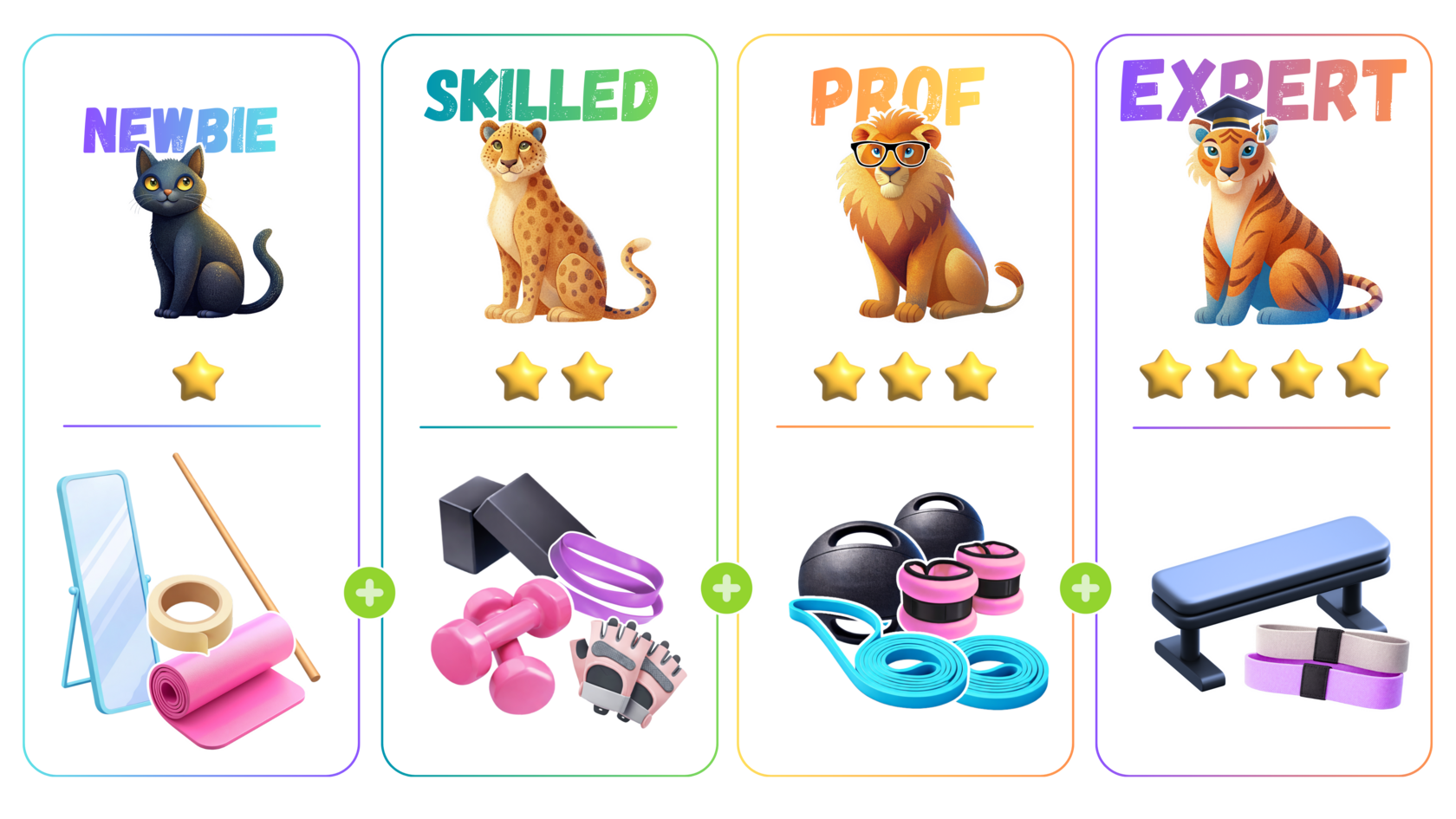
The Levels differ in the Level of physical activity and the fitness equipment and tools used in the training.
In particular, sports equipment varies from Level to Level. For example, we start with bodyweight and a fitness stick (or its analogue) at Level 1/4 Newbie, and then add additional equipment in each subsequent Level.

You will find detailed lists of the required fitness equipment and explanations below, separated by Level, as well as in the lessons for each level after you access them.

Level 1/4 Newbie Equipment / Tools List
Level 2/4 Skilled Equipment / Tools List
Level 3/4 Prof Equipment / Tools List
Level 4/4 Expert Equipment / Tools List

Note: The voiceovers in the equipment learning videos are in English. Given the international distribution of this program across various countries and the need for its varied language adaptations, the English voiceover in this version of the program has been superimposed over the original native voiceovers of the source videos. Therefore, the audio track in equipment learning videos with voiceovers may differ slightly from the original voiceover speed. For your convenience, each training video with voiceover also includes integrated English subtitles.

Level 1/4 Newbie Equipment / Tools List

A Full-length Mirror


A full-length mirror that can be hung on the wall or leaned against it. You should be able to fit completely in it, including your feet and arms raised or outstretched, while you're standing and performing exercises in your work area. The mirror should not distort proportions.

Masking Tape


Masking tape, 5 cm /1.9 in wide, can be purchased at any hardware store (and some hardware and art/office supply stores). We need it to mark out our work area (rug, mat, floor).

Fitness Mat (if needed)


The optimal mat thickness is 0.5 cm/0.2 in (or 1.0 cm/0.4 in for dense mats); anything thinner will be painful, while anything thicker will be too soft and compromise stability. The length and width should match your body length and size, so that when in a plank position with your hands under your shoulders and your legs straight, you can fit completely on the mat.

Fitness Stick / Analogue


An analogue of a fitness stick, regular (non-telescopic) mop, or broom pole will suffice, as long as it doesn't have a significant weight difference at the ends (for example, a heavy knob handle on one side). The pole/stick should be at least 1 meter (100 cm) long, preferably longer—1.2 meters (120 cm) or 1.4 meters (140 cm).

Cloth


Women are advised to wear sports bras, bras, or supportive tops (especially for cardio workouts). For both men and women, lightweight leggings, shorts, and (optionally) non-slip socks (with silicone caps) are suitable for work.


Clothing should not be tight or constricting. You should be able to breathe easily and fully during exercises, especially during the cardio warm-up blocks and breathing exercises.


Fingerless gloves can also be worn without lifting weights to prevent your hands from slipping when pressing on the floor during exercises.

Level 2/4 Skilled Equipment / Tools List

all equipment for Level 1/4 Newbie (mentioned above) + new fitness equipment

Fit gloves without fingers


New (not yet stretched) resistance bands can rub the skin on your fingers and palms, so we recommend using lightweight, fingerless cloth gloves when working with them.

The weight of the equipment should be < or = 10-15% of body weight. What's the point?


To achieve results in posture correction, after a certain period of training, it is necessary to use additional weights (dumbbells, resistance bands, medicine balls). However, for someone with posture problems, weight should be strictly limited to the upper permissible limit and should not exceed 10-15% of total body weight.


Let's look at some examples:


EXAMPLE 1

A woman weighing 60 kg should use weights in posture correction training, the total maximum weight of which should not exceed 6-9 kg.


In this specific case, these could be:

Elastic bands with a 5-7 kg rating

2 dumbbells weighing from 0.5 kg to 4 kg each

Wrist and ankle weights weighing from 0.5 kg to 2 kg each

Medicine balls and kettlebells with handles weighing from 2 to 8 kg


EXAMPLE 2

A 90 kg man should use weights in posture correction training, the total maximum weight of which should not exceed 9-14 kg.


In this particular case, these could be:

Elastic bands with a weight rating of 5.0-7.0 kg and 10.0-15.0 kg

2 dumbbells weighing from 2.5 kg to 7.0 kg each

Wrist and ankle weights weighing 2.0 kg each

Medicine balls and kettlebells with handles weighing from 4.0 to 14.0 kg


Progressing in weights should also be done carefully and gradually, starting with the specified lower weight limits.


VERY IMPORTANT:

There are limitations to the weights specified.


For example, for some exercises, even men should not use dumbbells heavier than 1.0-2.5 kg, and women should not use dumbbells heavier than 1.0 kg. This is due to the specific nature of the exercises and the muscles they work. Therefore, the recommendation for a total equipment weight of 10-15% is the upper limit for some exercises; it's not applicable to all exercises and is far from always appropriate (in general, always refer to the weight chart (picture below)).


In most exercises, the weight will be much less than 10-15% of body weight, or no weight at all. This means that, although the maximum allowable equipment weight for a 60 kg woman is 6-9 kg, she will perform the majority of her exercises with 1- and 1.5-kg dumbbells, and only a few with 2.5-9-kg dumbbells. The 9 kg will be the weight of the elastic bands, not the dumbbells, which are perceived by the muscles quite differently when working on posture correction.


The Course program will indicate equipment weight ranges for each exercise (in the training blocks for new exercises and in the workouts).


Why don't we work with medium and heavy weights?


IMPORTANT:

Using weights outside the specified range in strength training for postural problems will, at best, result in no progress and, at worst, worsen the situation.


Using light weights is the most important method in the IRENA ROST posture correction system. Why? The fact is that working with heavy weights "activates" only the large superficial muscles. Plus, to relieve excessive strain on the back muscles when working with heavy weights, the leg muscles automatically "activate," acting as levers and elevators. This doesn't include working the deep and middle muscles—the spinal stabilisers that support and extend the spinal column. They "turn off" when working with heavy weights and aren't involved in this work at all, because they're often inactive. The exercises we need with medium and heavy weights simply cannot be done.

You will need a resistance band of the following weight; please see the table below for weight graduations by gender/age and the video for details.

Resistance bands with a 5-7 kg/11-15 lbs strength:

They are usually the thinnest and weakest-looking of all the other bands with a higher strength, but appearances can be deceiving, and after you start using them, you'll realise that, when used correctly, a 5-7 kg/11-15 lbs band is the maximum weight we can use to work on posture problems. Typically, the band is 0.5-0.6 cm (0.2 in) thick, and its length (when folded in half) is 100-105 cm (39-41 in).


Resistance bands with a 10-15 kg/22-33 lbs strength:

Typically, the thickness of the band in such a band is 1.1-1.2 cm (0.4-0.5 in), and its length (when folded in half) is 105-110 cm (41-43 in).


IMPORTANT: Only adult men should purchase this type of band in addition to the 5-7 kg/11-15 lbs band.

You will need two dumbbells of the following weights; please see the table below for weight graduations by gender/age.

You will need two dumbbells of the following weights; please see the table below for weight graduations by gender/age.

You will need two dumbbells of the following weights; please see the table below for weight graduations by gender/age.

Dumbbells can look like this (different weights - different shapes and types):


Lightweight dumbbells (0.5 - 1 kg) are often found in stick/stick format, but they are also easy to find in standard formats. We recommend choosing models with side grips or hand grips, even for the lightest dumbbells, as very smooth, flat models can slip out of your hands during use.


Heavier dumbbells are classic designs with a small handle and two side weights and can be fully or partially rubberised. The appearance, shape, and comfort of the dumbbells depend on your preferences.

2 yoga blocks


We'll need two yoga blocks for some of the exercises at this level. Choose thicker ones for greater stability (we'll also be standing on them with our feet).

Level 3/4 Prof Equipment / Tools List

all equipment for Levels 1/4 Newbie, 2/4 Skilled (mentioned above) + new fitness equipment

2 brand new resistance bands (equal force and equal length)


Details on what the resistance bands should be like can be found in the information block in the 2/4 Skilled level. The details are here (in the infoblock above). You will also find important and useful instructions in the video below.

Medball, 4 kg/8.8 lbs


The video details the types of medicine balls needed and how to create their equivalents. The graphic instructions below provide a weight chart for children, teenagers, and adults.

Medball, 2 kg/4.4 lbs


The video details the types of medicine balls needed and how to create their equivalents. The graphic instructions below provide a weight chart for children, teenagers, and adults.

2 wrist weights, 0.5 kg/ 1.1 lbs


The video provides detailed information on the required weights, and the graphic instructions below include a weight chart for children, teenagers, and adults.

2 wrist weights, 1 kg/ 2.2 lbs


The video provides detailed information on the required weights, and the graphic instructions below include a weight chart for children, teenagers, and adults. The details about the dumbbells' weight are here (in the infoblock above).

Level 4/4 Expert Equipment / Tools List

all equipment for Levels 1/4 Newbie, 2/4 Skilled and 3/4 Prof (mentioned above) + new fitness equipment

Cloth band, 5-9 kg/11-20 lbs


In the video, details about what kind of elastic band is needed, and in the graphic instructions below, a weight table for children, teenagers and adults.

Bench of a sofa


We'll need two yoga blocks for some of the exercises at this level. Choose thicker ones for greater stability (we'll also be standing on them with our feet).